

A spiked roller is a technical tool designed to regulate the behavior of freshly applied coatings, ensuring that the material settles, levels, and cures in a controlled manner. During the installation of resin floors, self-leveling compounds, and liquid-applied membranes, the material is at its most sensitive stage. Air becomes trapped, surface tension creates waves, and viscosity changes influence flow. A spiked roller is used specifically to correct these early-stage issues. Because it intervenes before the coating begins to cure, the tool prevents defects that would otherwise become permanent.
Manufacturers such as Nichiyo design spiked rollers with stable spike spacing and durable construction to maintain consistent performance. For users seeking a dependable option, the full range is available here: Nichiyo Spiked Roller.
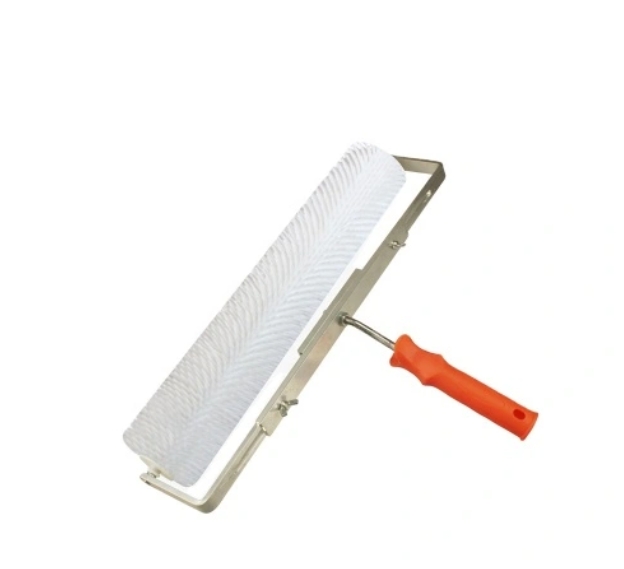
1. The Functional Principle Behind a Spiked Roller
Liquid coatings hold internal tension and contain air introduced during mixing. If these forces are not managed, the coating traps bubbles and cures with visible irregularities. The spikes on the roller penetrate the coating briefly, creating temporary channels that allow air to escape upward. As soon as the spike lifts, the fluid material flows back into place. This momentary disturbance resets the surface so the coating settles more uniformly.
Another principle involves tension relaxation. Fresh coatings often resist free flow because the surface develops micro-tension zones. The roller disrupts these zones so gravity and viscosity—not the memory of how the coating was poured—determine the final shape. This is why the tool is used immediately after spreading: it influences how the coating organizes itself before curing begins.
2. How Spiked Rollers Optimize Fresh Coating Behavior
Below are the main ways the roller improves coating behavior. Each point contains short, separated paragraphs for clarity.
2.1 Disrupting Surface Tension
Coatings show natural tension patterns caused by pouring and tool movement. These patterns can leave shallow ridges or depressions that remain after curing.
The spiked roller resets the surface by breaking tension pockets, allowing the coating to relax.
Once tension is removed, the coating flows evenly. This ensures the finished layer appears smoother and more consistent across the full surface.
2.2 Releasing Entrapped Air
Mixing traps air inside resins and cementitious products, especially when high-speed mixers are used.
The spikes open vertical channels that give bubbles an immediate escape path.
This prevents pinholes, pores, and dull spots. A bubble-free surface cures with greater density and clarity, which is essential for transparent or decorative systems.
2.3 Equalizing Material Thickness
Coatings tend to accumulate in certain areas and remain thin in others, especially on large floors.
Rolling encourages redistribution without moving material directionally.
After rolling, thickness becomes more uniform, supporting consistent load-bearing characteristics and predictable curing across the surface.
2.4 Preventing Early Skin Formation
Some formulations begin forming a surface film before internal movement has stopped.
Because the roller continues to penetrate the coating, it delays premature sealing.
This allows internal air release and thickness adjustment to finish naturally, reducing defects caused by uneven curing.
2.5 Stabilizing Decorative Effects
Metallic pigments and flakes can drift or settle unevenly.
Although the roller does not blend colors, it stabilizes the surface long enough for visual elements to remain in place.
This results in more controlled patterns and cleaner visual consistency.
3. Avoiding Structural and Visual Defects in Flooring Systems
Many defects originate within minutes of pouring, long before the coating fully cures. A spiked roller prevents these issues by managing the material while it is still fluid.
Air bubbles, surface waves, and shallow craters often appear after curing if the material has not been rolled properly. Installers use the roller because it reduces the need for grinding, patching, and refinishing.
The following table illustrates the difference between unrolled and rolled coatings:
| Condition | Without Spiked Roller | With Spiked Roller |
|---|---|---|
| Air bubbles | Become trapped and visible | Released through spike channels |
| Pinhole marks | Form near surface | Prevented by early air escape |
| Surface waves | Caused by uneven tension | Neutralized by tension disruption |
| Thickness variation | Leads to curing differences | Layer becomes uniform |
| Micro-craters | Appear randomly | Material settles smoothly |
Because professional-grade floors require structural uniformity, the roller becomes a preventive instrument. Rather than correcting problems later, installers minimize risk during the short “open time” when the coating remains workable.
4. Supporting the Installation Workflow in Large-Scale Projects
Large flooring projects demand synchronized timing and controlled material behavior. Spiked rollers support efficiency during these high-volume installations.
4.1 Keeping Surface Conditions Consistent
Sections of a large floor begin curing at different times.
Rolling ensures that each section stabilizes immediately after application.
This prevents visible transitions and maintains a consistent appearance across the entire area.
4.2 Assisting Team Coordination
Installation teams work in stages: mixing, pouring, spreading, and finishing.
The roller’s quick pass-through action allows one technician to manage large areas efficiently.
This coordination prevents delays and keeps the entire workflow within the material’s allowable working window.
4.3 Managing Fast-Curing Systems
Rapid-setting coatings offer shorter project timelines but leave little margin for error.
The roller helps complete air release and tension reduction before viscosity increases too much.
This stabilizes the material while still allowing it to cure rapidly once the rolling process is finished.
4.4 Reducing Corrective Work
Reworking hardened coatings requires grinding and extra materials.
Early rolling eliminates defects that would later require repair, improving overall efficiency.
This is especially valuable in industrial environments where downtime is costly.
4.5 Supporting Edges, Joints, and Transitions
Uneven areas around joints and edges may cause pooling.
A spiked roller redistributes material gently, encouraging smoother flow around these features.
This results in a more predictable final appearance even in challenging sections of the installation.
5. Why Professional Installers Rely on Tools Like the Nichiyo Spiked Roller
Installers depend on spiked rollers because the tool directly influences curing quality and long-term performance. A high-quality roller must maintain spike integrity, spacing accuracy, and smooth rotation. Tools such as the Nichiyo Spiked Roller are engineered with these requirements in mind, making them reliable for both small-scale and large-scale projects.
Manufacturers design these rollers not as decorative tools but as critical instruments that prevent structural defects. When installers control air release, flow behavior, and layer uniformity, they reduce failures and increase surface durability. As coatings continue to evolve, the roller remains one of the most important devices for achieving smooth and defect-free finishes.
Conclusion
A spiked roller is used to release air, break surface tension, equalize thickness, prevent early defects, and support efficient installation workflows. Its purpose is preventive: ensuring fresh coatings behave predictably before curing.
For professionals seeking dependable performance, Nichiyo manufactures spiked rollers built for consistent results. More information is available here: Nichiyo Spiked Roller.
Proper use of this tool allows coatings to develop clarity, density, and smoothness, making it essential in modern flooring and coating applications.